Smart Car Key Fob
A haptic-enabled e-paper key fob that prioritizes immediate utility and physical ergonomics over digital an app.
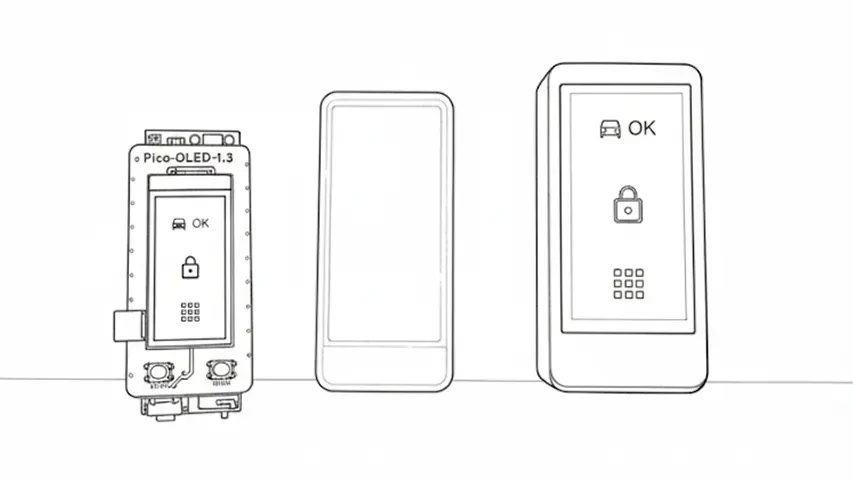
The smart car key fob prototype
Situation:
Existing automotive mobile applications often suffer from information overload, hidden features, and reliance on internet connectivity, which creates friction for users in high-stress, mobile environments like parking garages.
Task:
The objective was to design a dedicated interactive key fob that provides situational awareness and essential vehicle data through “micro-interactions,” effectively minimizing cognitive load for the user.
Action:
- Applied Fitts’ Law to iterate on the physical interface, widening interactive zones and moving from small screen targets to physical side buttons to reduce the “index of difficulty” and prevent Slips during high-stress usage.
- Mitigated e-paper display latency by decoupling visual and tactile responses; implemented Haptic Signifiers to provide Immediate Feedback, ensuring the user’s Mental Model remained aligned with system performance despite asynchronous screen updates.
- Optimized Mapping between the device’s “compass” feature and the external world, ensuring directional feedback matched the user’s spatial orientation.
- Bridged the Gulf of Evaluation by utilizing a persistent e-paper state that allows users to perceive car status at a single glance without power or device unlocking.
- Used the physical prototype as a Communication Device and tool for exploration to identify and resolve usability issues that static wireframes could not uncover.
Result:
Developed a refined, high-fidelity functional prototype that successfully balanced the trade-offs of low-power hardware with the need for responsive interaction. The final design significantly reduced the Gulf of Execution compared to traditional apps by enabling “eyes-free” interaction and instant confirmation of vehicle security.